Robotic Welding Cells Guide: Explore Types, Components, Applications, Safety, and Planning Factors
A robotic welding cell is an automated manufacturing area where an industrial robot works with welding equipment, fixtures, controls, and safety systems to join metal components. A robotic welding cells guide helps explain how these systems operate, what components they contain, where they are used, and which factors influence their design.
Welding has traditionally depended heavily on skilled manual operation. As manufacturing requirements became more focused on repeatability, production consistency, and controlled movement, robots became increasingly useful for repetitive welding tasks. A robot can follow programmed paths while a welding power source controls the electrical characteristics of the welding process.
A complete robotic welding cell is more than a robot arm. It is an integrated system in which the robot, welding torch, workholding equipment, sensors, control hardware, safety devices, and material-handling equipment operate together.
What Is a Robotic Welding Cell?
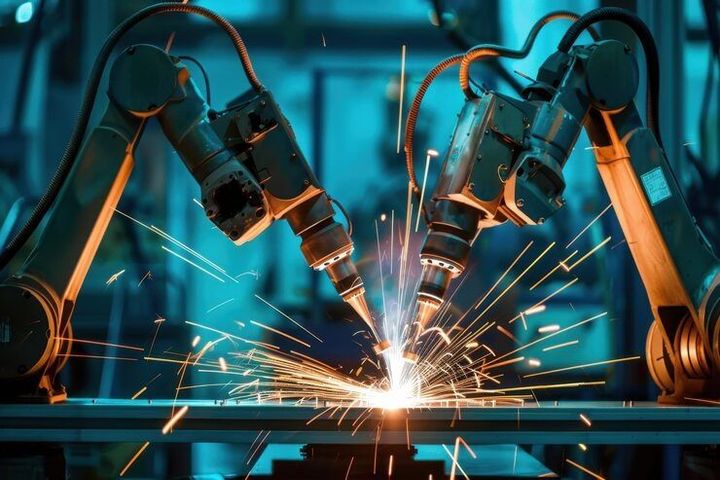
A robotic welding cell is a defined workspace designed around one or more automated welding operations. The robot moves the welding torch along programmed paths while a fixture holds the workpiece in a known position.
Depending on the application, a cell may also contain a positioner that rotates or tilts the workpiece. This can allow the robot to reach different welding locations without requiring the robot itself to make every movement.
The welding process may involve methods such as gas metal arc welding, gas tungsten arc welding, resistance spot welding, or other specialized techniques. The selected process depends on the material, joint design, component dimensions, and production requirements.
How a Robotic Welding Cell Works
The general operating sequence is relatively straightforward:
- A workpiece is placed into a fixture or loading area.
- Sensors or controls confirm that the required conditions are met.
- The safety system permits the programmed cycle to begin.
- The robot moves the welding torch along the programmed path.
- The welding equipment supplies the required welding current and related parameters.
- The robot completes the programmed sequence.
- The finished assembly is removed or transferred for inspection.
The actual sequence can vary significantly between applications. Some cells use manual loading, while others integrate conveyors, automatic part loading, or multiple workstations.
Importance
Robotic welding cells are important because welding often involves repetitive movements, controlled torch positioning, heat exposure, fumes, and demanding production schedules. Automation can perform programmed movements repeatedly while separating people from some of the direct hazards associated with welding operations.
These systems are used in industries that manufacture repeated metal assemblies. Common examples include automotive components, agricultural equipment, construction equipment, industrial machinery, metal structures, appliances, and fabricated assemblies.
Problems Addressed by Robotic Welding
Manual welding can involve variation in torch angle, travel speed, position, and weld path. A programmed robot can repeat a defined movement sequence, which can help create more consistent process conditions when the parts and fixtures are also consistent.
Robotic systems can also handle repetitive welding patterns that may require many similar movements. This can reduce the amount of continuous manual manipulation needed for particular production processes.
However, automation does not automatically eliminate welding defects. Poor fixture alignment, incorrect welding parameters, unsuitable joint design, wire-feed problems, contamination, or inaccurate programming can still affect weld quality.
Main Advantages and Limitations
A robotic welding cell can provide several operational characteristics:
- Repeatable programmed movement
- Controlled torch positioning
- Integration with automated fixtures
- Consistent execution of repetitive weld paths
- Data collection through connected controls
- Separation of operators from some welding hazards
There are also limitations. Robotic systems generally require suitable component consistency, accurate fixtures, appropriate programming, maintenance, and trained personnel. Complex parts with frequent design changes may require more programming and setup work than highly repetitive assemblies.
Recent Updates
Robotic welding technology has continued to develop through greater integration of sensors, digital controls, machine vision, data collection, and flexible programming. These developments are part of the broader movement toward connected and automated manufacturing.
A significant standards development occurred with the publication of ISO 10218-1:2025 and ISO 10218-2:2025. The first standard addresses safety requirements for industrial robots, while the second focuses on industrial robot applications and robot cells, including integration, commissioning, operation, maintenance, and decommissioning.
Sensors and Vision Systems
Modern robotic welding cells can incorporate sensors that monitor workpiece position, seam location, torch position, or other process conditions. Vision systems can also help identify component locations and compensate for variations in part positioning.
Some welding applications use seam-tracking technology to detect the actual joint position while the robot is operating. This can be useful when minor variations in component placement make a fixed programmed path less suitable.
Digital Monitoring
Connected controllers can collect information about production cycles, welding parameters, alarms, and equipment conditions. Data from these systems can be used to identify recurring process problems and understand how a cell is operating over time.
This development also supports integration with broader manufacturing software and industrial networks. The specific communication capabilities depend on the robot controller, welding equipment, programmable logic controller, and factory infrastructure.
Flexible Robotic Systems
Manufacturers are also using modular fixtures, programmable positioners, quick-change tooling, and more flexible robot programming to handle product variations. These approaches can make robotic welding cells more adaptable than systems designed around only one fixed assembly.
Laws or Policies
In India, robotic welding cells are influenced by workplace safety requirements, machinery-related standards, welding safety practices, and applicable industrial regulations. The Occupational Safety, Health and Working Conditions Code, 2020 is part of India's labour-code framework, which is maintained by the Ministry of Labour and Employment.
Welding operations also involve hazards such as electric shock, arc radiation, hot surfaces, fumes, gases, fire, and moving machinery. Indian Standard IS 818 addresses safety and health requirements for electric and gas welding and cutting operations.
Robot-specific safety is another important consideration. BIS has published Indian standards based on earlier editions of ISO 10218, and a 2024 BIS draft addressed requirements for integrating industrial robot applications and robot cells.
The international ISO 10218 series was updated in 2025. ISO 10218-2:2025 specifically addresses the integration of industrial robot applications and robot cells throughout stages such as design, commissioning, operation, maintenance, and decommissioning.
BIS provides a “Know Your Standard” portal where users can search Indian Standards using an IS number or keyword and review related documents and information.
Applicable requirements can differ according to the workplace, equipment, welding process, industry, and location. A general guide cannot determine the exact compliance requirements for a particular installation.
Key Safety Measures
A robotic welding cell normally requires multiple layers of protection. These can include physical guarding, access doors, interlocks, emergency-stop devices, warning indicators, safety-rated controls, and controlled access areas.
Welding-specific protection may also involve ventilation, fume extraction, suitable eye and face protection, fire prevention measures, grounding, and appropriate handling of shielding gases.
Safety systems should be designed around the actual hazards of the complete cell rather than considering the robot arm alone. ISO 10218-2:2025 specifically addresses the integration of robots with other machines and components within a complete robot application.
Tools and Resources
Several technical resources can help readers understand, plan, and evaluate robotic welding cells.
Robot and Welding Specifications
Robot specifications normally describe payload, reach, axes of movement, repeatability, mounting arrangements, and allowable operating conditions. Welding equipment documentation provides information about welding processes, current ranges, wire systems, torch configurations, and compatible controls.
These specifications should be considered together because the robot must be able to position the welding torch correctly while the welding system provides the required process characteristics.
Fixture Design Resources
Fixture drawings and workholding guidelines help determine how components will be positioned during welding. A fixture should provide stable positioning while allowing access to the required weld locations.
Important considerations include datum locations, clamping points, accessibility, distortion control, loading direction, and repeatable positioning.
Safety Standards
ISO 10218-1:2025 provides requirements for industrial robots, while ISO 10218-2:2025 covers robot applications and robot cells. These standards provide a structured reference for safety considerations involving robot design and system integration.
For Indian requirements, the BIS standards database can be used to identify applicable standards by keyword or standard number.
Planning Checklist
Before designing a robotic welding cell, planners generally examine:
| Planning factor | Key consideration |
|---|---|
| Part geometry | Shape, dimensions, and weld locations |
| Material | Steel, aluminum, stainless steel, or other material |
| Welding process | Appropriate welding method |
| Robot reach | Access to all required weld locations |
| Payload | Torch, cables, tooling, and related equipment |
| Fixture | Accurate and repeatable workholding |
| Positioner | Required rotation or movement of the workpiece |
| Production flow | Loading, welding, inspection, and unloading |
| Safety | Guarding, access control, emergency stopping |
| Utilities | Electrical power, shielding gas, compressed air, and ventilation |
| Quality control | Weld inspection and process monitoring |
| Maintenance | Access to components and planned maintenance activities |
A clear assessment of these factors helps determine whether a robotic welding cell is technically suitable for a particular production environment.
FAQs
What is a robotic welding cell?
A robotic welding cell is an enclosed or controlled manufacturing area where an industrial robot performs programmed welding operations. It normally includes a robot, welding equipment, fixtures, controls, and safety systems.
How does a robotic welding cell work?
A robotic welding cell positions a workpiece in a fixture and uses a programmed robot to move a welding torch along defined paths. The welding equipment controls the welding process while the cell's safety system controls access and operation.
What are the main components of a robotic welding cell?
Common components include an industrial robot, robot controller, welding power source, welding torch, wire-feeding system where applicable, fixtures, positioners, sensors, safety equipment, control panels, and material-handling equipment.
What industries use robotic welding cells?
Robotic welding cells are used in automotive manufacturing, metal fabrication, agricultural equipment, construction equipment, machinery production, appliances, and other industries that produce repeated welded assemblies.
What safety standards apply to robotic welding cells?
ISO 10218-1:2025 covers industrial robot safety requirements, while ISO 10218-2:2025 addresses industrial robot applications and robot cells. Welding operations may also be subject to applicable national standards and workplace safety requirements, including relevant Indian Standards in India.
Conclusion
A robotic welding cell combines an industrial robot with welding equipment, fixtures, controls, sensors, and safety systems to perform programmed welding operations. Its design depends on part geometry, welding method, robot reach, fixture accuracy, production flow, and safety requirements. Recent developments have increased the use of sensors, digital monitoring, flexible programming, and updated robot-cell safety standards. In India, applicable labour requirements and relevant BIS standards provide important references for workplace and equipment safety.