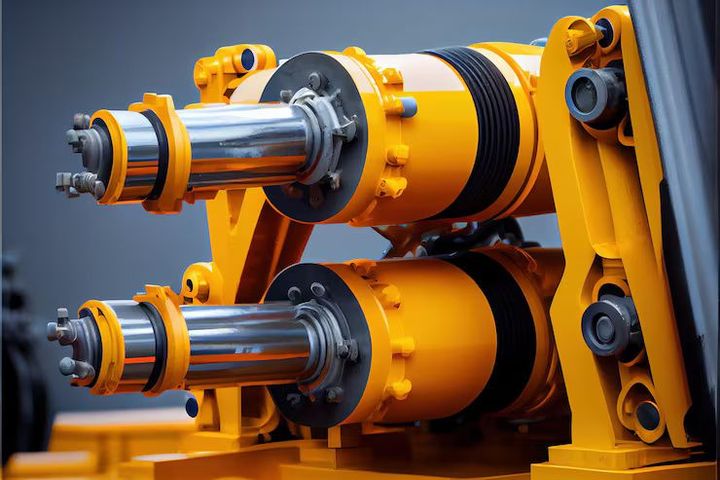
Hydraulic Cylinders Guide: Explore Types, Components, Applications, Force, and Selection Factors
A hydraulic cylinder is a mechanical actuator that converts hydraulic fluid pressure into linear movement and force. Hydraulic cylinders are used in equipment that needs controlled pushing, pulling, lifting, pressing, tilting, or positioning. A hydraulic cylinders guide provides an overview of their types, components, applications, force calculations, and important selection factors.
The basic principle behind a hydraulic cylinder is based on fluid pressure acting against a piston. When pressurized hydraulic fluid enters one side of the cylinder, it pushes the piston and causes the attached rod to move. Reversing or redirecting the fluid flow can move the piston in the opposite direction in suitable cylinder designs.
Hydraulic cylinders are widely associated with construction machinery, agricultural equipment, industrial machinery, material-handling systems, waste-processing equipment, and mobile hydraulic systems. Their ability to generate substantial linear force within a relatively compact mechanism makes them useful where mechanical movement needs to be controlled through hydraulic pressure.
How Hydraulic Cylinders Developed
Early hydraulic systems used basic principles of fluid pressure for lifting and mechanical movement. As hydraulic technology developed, manufacturers introduced improved cylinders, seals, materials, valves, pumps, and control systems.
Modern hydraulic cylinders are available in many configurations. Their dimensions, mounting arrangements, pressure ratings, stroke lengths, and materials can vary according to the equipment in which they are installed.
Basic Hydraulic Cylinder Operation
A typical hydraulic cylinder contains a cylindrical barrel, piston, piston rod, seals, and mounting components. Hydraulic fluid enters the cylinder through a port and applies pressure to the piston.
The relationship between pressure and piston area determines the theoretical force produced by the cylinder. A larger piston area can generate greater force at the same hydraulic pressure, while the available stroke determines how far the rod can travel.
Importance
Hydraulic cylinders play an important role in machines that require controlled linear movement. Construction equipment such as excavators and loaders uses cylinders for movements involving booms, buckets, arms, and other attachments. Agricultural machinery can use cylinders for steering, lifting, adjustment, and positioning.
Industrial equipment also uses hydraulic cylinders for pressing, clamping, forming, lifting, and material handling. Because cylinders can operate with substantial force, their design and selection affect machine movement, stability, operating speed, and safety.
Common Applications
Hydraulic cylinders can be found in many equipment categories:
- Excavators and other earthmoving machinery
- Wheel loaders and material-handling equipment
- Agricultural tractors and implements
- Hydraulic presses
- Lifting platforms and equipment
- Industrial production machinery
- Waste compactors
- Mining and quarrying equipment
- Marine and offshore equipment
- Forestry machinery
- Vehicle-mounted hydraulic systems
The same general cylinder principle can be adapted to different environments by changing dimensions, materials, seals, mounting arrangements, and operating specifications.
Why Cylinder Selection Matters
A hydraulic cylinder must match the mechanical requirements of the equipment. Important factors include the required force, stroke length, operating pressure, speed, mounting arrangement, available space, environmental conditions, and expected duty cycle.
An unsuitable cylinder can create problems such as insufficient movement, excessive mechanical stress, leakage, instability, or premature component wear. The cylinder should therefore be considered together with the pump, valves, hoses, mechanical structure, and control system.
Types
Hydraulic cylinders can be classified according to their operating arrangement, construction, and intended application.
Single-Acting Cylinders
A single-acting hydraulic cylinder uses hydraulic pressure to move the piston primarily in one direction. The return movement can be produced by gravity, an external load, a spring, or another mechanical arrangement.
These cylinders are used in applications where powered movement is required in one direction and another force can provide the return movement.
Double-Acting Cylinders
A double-acting hydraulic cylinder uses hydraulic pressure on both sides of the piston. Fluid can be directed to either side, allowing the cylinder to extend and retract under hydraulic power.
Double-acting designs are common in equipment requiring controlled movement in both directions.
Telescopic Cylinders
A telescopic cylinder contains multiple nested stages that extend progressively. This arrangement allows a relatively short retracted length to produce a comparatively long stroke.
Telescopic cylinders are used in equipment where installation space is limited but substantial extension is required, including some tipping and lifting applications.
Tie-Rod Cylinders
Tie-rod cylinders use external rods to hold the end caps and barrel assembly together. They are commonly used in industrial hydraulic applications because individual components can be accessible for inspection or replacement.
Welded Cylinders
Welded hydraulic cylinders use welded construction in parts of the cylinder body and are commonly found in mobile equipment and demanding applications. Their construction can provide a compact configuration suitable for equipment with space limitations.
Components
Understanding hydraulic cylinder components makes it easier to understand how the complete assembly works.
Barrel and Piston
The cylinder barrel provides the internal chamber in which the piston moves. The piston separates the pressure areas and transfers hydraulic pressure into mechanical force.
Piston Rod
The piston rod connects the internal piston to the external machine component. As the piston moves, the rod extends or retracts and transfers the resulting force to the connected mechanism.
Seals
Seals help prevent hydraulic fluid from escaping and help keep contaminants from entering the cylinder. Common sealing locations include the piston, rod, and cylinder head.
Seal material and design depend on factors such as hydraulic fluid, pressure, temperature, speed, and environmental exposure.
Rod and Piston Bearings
Bearing surfaces help guide moving components and reduce unwanted contact between parts. They can also help manage side loads within the limits of the cylinder design.
Ports and Mounting Components
Hydraulic ports provide the connection between the cylinder and hydraulic lines. Mounting components connect the cylinder to the machine and can include clevises, trunnions, flanges, spherical bearings, or other arrangements.
Cushioning Systems
Some cylinders include adjustable or fixed cushioning near the end of the stroke. Cushioning slows the piston near the end of travel and can reduce impact when the piston approaches the cylinder head or cap.
Force
Hydraulic cylinder force depends mainly on hydraulic pressure and the effective piston area.
For extension, the basic theoretical relationship is:
Force = Pressure × Piston Area
For a circular piston, area can be calculated using:
Area = π × Diameter² ÷ 4
For example, a cylinder with a 50 mm piston diameter has a piston area of approximately 1,963 mm². At a hydraulic pressure of 10 MPa, the theoretical extension force is approximately 19.6 kN before accounting for friction, pressure losses, mechanical losses, and other real-world factors.
Retraction force is generally lower for a conventional single-rod cylinder because the piston rod occupies part of the piston area. The approximate retraction area is:
Retraction Area = Piston Area − Rod Area
Therefore, the theoretical retraction force is:
Retraction Force = Pressure × Retraction Area
| Parameter | Example | Purpose |
|---|---|---|
| Piston diameter | 50 mm | Determines piston area |
| Rod diameter | 25 mm | Reduces retraction area |
| Pressure | 10 MPa | Hydraulic operating pressure |
| Extension area | 1,963 mm² | Used for extension force |
| Approx. extension force | 19.6 kN | Theoretical value |
| Approx. retraction area | 1,473 mm² | Used for retraction force |
| Approx. retraction force | 14.7 kN | Theoretical value |
Actual force can be lower than the theoretical calculation because of seal friction, pressure losses, fluid restrictions, temperature effects, and mechanical loading.
Selection Factors
Selecting a hydraulic cylinder involves more than comparing diameter and stroke. The cylinder must be compatible with the complete hydraulic and mechanical system.
Bore Diameter
The bore diameter determines the piston area. A larger bore generally produces greater theoretical force at the same pressure, assuming other conditions remain comparable.
Stroke Length
Stroke length describes the distance the piston rod can travel. It should correspond to the required mechanical movement without creating unnecessary extension.
Operating Pressure
The cylinder's rated pressure should be appropriate for the hydraulic system. The system's maximum pressure, pressure spikes, and operating conditions should also be considered.
Rod Diameter
Rod diameter affects mechanical strength, buckling resistance, retraction area, and overall cylinder dimensions. Long-stroke cylinders may require particular attention to rod stability and side loading.
Mounting Arrangement
The mounting method determines how the cylinder connects to the machine. Common arrangements include clevis, flange, trunnion, foot, and spherical mounting systems.
Speed and Flow
Cylinder speed depends on hydraulic flow and effective cylinder area. In simplified terms, higher flow can increase cylinder speed, although actual speed is affected by system restrictions, load, valve configuration, and pressure conditions.
Environmental Conditions
Temperature, dust, moisture, chemicals, outdoor exposure, and corrosive environments can influence cylinder materials and seal selection. Equipment used outdoors may require different protection from equipment operating in a controlled indoor environment.
Load and Side Forces
Hydraulic cylinders are primarily designed to apply axial force. Excessive side loading can increase wear on rods, bearings, and seals. The machine's linkage should therefore be designed so that the cylinder is not subjected to loads outside its intended operating conditions.
Recent Updates
From 2024 through 2026, hydraulic-cylinder development has increasingly followed broader trends in machine automation, condition monitoring, energy efficiency, and digital control.
Sensors can be integrated into hydraulic systems to monitor piston position, pressure, temperature, or other operating parameters. This information can be connected to electronic control systems for machine monitoring and automated movement.
Electro-hydraulic systems are also becoming more integrated. Electronic controls can regulate valves and coordinate cylinder movement with other machine functions. In mobile machinery, this can support more precise control of hydraulic functions while integrating with broader machine-control architectures.
Another continuing trend is condition monitoring. Pressure, temperature, vibration, position, and operating-cycle information can provide useful data for identifying changes in system behavior. The exact monitoring approach depends on the equipment and hydraulic architecture.
Cylinder manufacturers are also continuing to work with improved sealing systems, surface treatments, materials, and manufacturing methods. These developments are intended to address operating environments involving high pressure, contamination, temperature variation, and repeated movement.
Laws or Policies
In India, hydraulic equipment used in industrial workplaces can fall under workplace health and safety requirements applicable to the particular facility and machinery. The Occupational Safety, Health and Working Conditions Code provides a broader legal framework covering occupational safety and working conditions.
For pressure-related equipment, the applicable requirements depend on the equipment configuration and whether it falls under specific pressure-vessel, machinery, factory, or other regulatory provisions. Hydraulic systems can also be subject to workplace procedures concerning guarding, maintenance, inspection, training, and safe operation.
Relevant Indian Standards may apply to particular hydraulic components, machinery, or testing procedures. The applicable standard depends on the cylinder type and its intended application.
For equipment used in a regulated industrial environment, requirements should be checked against the current central and state rules, applicable standards, manufacturer documentation, and workplace safety procedures. General information about hydraulic cylinders does not replace a formal engineering or safety assessment.
Tools and Resources
Several technical resources can help with hydraulic-cylinder calculations and system understanding.
Hydraulic Force Calculators
Hydraulic force calculators can estimate theoretical cylinder force using piston diameter and hydraulic pressure. Some calculators also include rod diameter and retraction-force calculations.
The results should be treated as engineering estimates because real systems experience friction, pressure losses, mechanical constraints, and varying operating conditions.
Hydraulic Circuit Diagrams
Hydraulic circuit diagrams show how pumps, valves, cylinders, reservoirs, filters, hoses, and other components interact. They can help readers understand how fluid reaches the cylinder and how movement is controlled.
Manufacturer Catalogs and Manuals
Technical catalogs commonly provide cylinder dimensions, pressure ratings, stroke ranges, mounting configurations, seal information, and other specifications. A cylinder's technical documentation is important when checking compatibility with an existing hydraulic system.
Calculation References
For a basic cylinder-force calculation, the following information is useful:
- Piston diameter
- Rod diameter
- Hydraulic pressure
- Required extension force
- Required retraction force
- Stroke length
- Operating speed
- Hydraulic flow rate
- Mounting dimensions
- Environmental conditions
These values provide a starting point for understanding cylinder requirements, while detailed machine design may require additional calculations.
FAQs
What is a hydraulic cylinder?
A hydraulic cylinder is a mechanical actuator that converts hydraulic fluid pressure into linear mechanical movement. It can be used to push, pull, lift, tilt, clamp, or position a load.
How do you calculate hydraulic cylinder force?
Hydraulic cylinder force can be estimated using the formula Force = Pressure × Piston Area. For a circular piston, piston area is calculated from its diameter. Actual force can be lower because of friction and pressure losses.
What are the main hydraulic cylinder types?
Common types include single-acting, double-acting, telescopic, tie-rod, and welded hydraulic cylinders. The appropriate type depends on the required movement, mounting arrangement, pressure, stroke, and application.
What are the main components of a hydraulic cylinder?
Major components include the barrel, piston, piston rod, seals, bearings, ports, mounting components, and, in some designs, cushioning mechanisms. Each component contributes to controlled hydraulic movement.
What factors should be considered when selecting a hydraulic cylinder?
Important selection factors include bore diameter, stroke length, rod diameter, operating pressure, required force, cylinder speed, mounting configuration, side loading, environmental conditions, and available installation space.
Conclusion
Hydraulic cylinders convert pressurized hydraulic fluid into controlled linear movement and are used across mobile, industrial, agricultural, construction, and material-handling equipment. Their performance depends on factors such as piston area, hydraulic pressure, stroke, rod dimensions, seals, mounting, and operating conditions. Recent hydraulic systems increasingly incorporate sensors, electronic controls, and condition-monitoring technologies. Applicable safety requirements, technical standards, and manufacturer specifications should be considered when hydraulic cylinders are installed or operated.