Commercial Water Chillers Explained: Types, Components, Cooling Capacity, Applications, Efficiency, Benefits and Selection Considerations
Commercial water chillers are mechanical cooling systems used to remove heat from water and circulate the cooled water through buildings or industrial processes. The cooled water can then pass through air-handling units, fan-coil units, process equipment, or other heat-transfer equipment to provide controlled cooling. Understanding commercial water chillers involves looking at their types, components, cooling capacity, applications, efficiency, benefits, and selection considerations.
A typical chiller uses a refrigeration cycle to transfer heat from chilled water to another medium. Depending on the design, heat may be rejected to outdoor air or to condenser water connected to a cooling tower. This arrangement allows a central cooling system to serve multiple areas from one location.
Water chillers are commonly found in office buildings, hotels, hospitals, shopping centers, educational facilities, data centers, manufacturing plants, and other large facilities. Their size and configuration can vary considerably depending on the required cooling load and operating conditions.
Basic Chiller Operating Principle
A commercial chiller generally contains four major refrigeration-cycle stages: compression, condensation, expansion, and evaporation.
The compressor raises the pressure and temperature of the refrigerant. The condenser then transfers heat away from the refrigerant. After passing through an expansion device, the refrigerant enters the evaporator, where it absorbs heat from the circulating chilled water.
The cooled water is then pumped through a building or process loop. After absorbing heat, the warmer return water flows back to the chiller, where the cycle begins again.
Air-Cooled and Water-Cooled Systems
Commercial water chillers are commonly classified according to how heat is rejected.
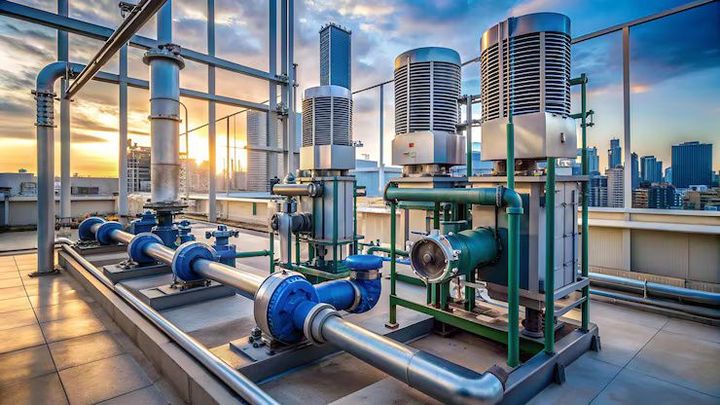
Air-cooled chillers use fans and condenser coils to release heat directly into outdoor air. They generally have a simpler heat-rejection arrangement because they do not require a cooling tower and condenser-water loop.
Water-cooled chillers transfer condenser heat into a separate water circuit. The heated condenser water usually moves to a cooling tower, where heat is released into the atmosphere.
The appropriate arrangement depends on building conditions, climate, available space, cooling requirements, water availability, maintenance arrangements, and energy objectives.
Importance
Commercial cooling systems can represent a significant portion of energy use in large buildings and facilities. Chiller performance therefore has a direct relationship with overall HVAC operation and building energy management.
A properly planned chilled-water system can provide centralized temperature control across multiple areas. It can also support different cooling loads at the same time through separate air-handling and water-distribution systems.
Where Commercial Water Chillers Are Used
Commercial water chillers are used in many environments, including:
- Office buildings with centralized HVAC systems
- Hotels and large accommodation facilities
- Hospitals and healthcare buildings
- Shopping centers and retail complexes
- Educational institutions
- Airports and transportation facilities
- Data centers and technology facilities
- Industrial plants
- Food and beverage processing facilities
- Manufacturing environments requiring process cooling
In some facilities, chillers support human comfort, while in others they remove heat from equipment or manufacturing processes.
Why Cooling Capacity Matters
Cooling capacity describes how much heat a chiller can remove during a specified operating condition. It is commonly expressed in tons of refrigeration, kilowatts of cooling capacity, or other engineering units.
Selecting a system with insufficient capacity can make it difficult to maintain the required temperature during periods of high demand. A system that is substantially oversized may experience frequent cycling or inefficient part-load operation.
Cooling load calculations should therefore consider building size, insulation, occupancy, equipment heat, outdoor conditions, ventilation requirements, solar heat gain, and process requirements rather than relying only on floor area.
Types of Commercial Water Chillers
Different chiller configurations are designed for different operating conditions. The main distinctions involve compressor technology, heat-rejection method, and control arrangement.
Reciprocating Chillers
Reciprocating chillers use piston-driven compressors. The movement of pistons compresses the refrigerant before it enters the condenser.
This design has historically been used for smaller cooling applications. Multiple compressor arrangements can allow capacity to be adjusted according to demand.
Scroll Chillers
Scroll chillers use two spiral-shaped elements to compress refrigerant. One scroll remains stationary while the other moves in an orbital pattern.
They are commonly associated with smaller and medium-capacity cooling systems. Multiple scroll compressors can be combined in one system to provide staged capacity control.
Screw Chillers
Screw chillers use rotating screw-shaped compressor components. They are commonly applied to medium and larger cooling requirements.
Screw compressors can operate across varying loads with appropriate controls. Their configuration makes them suitable for many commercial and industrial cooling systems.
Centrifugal Chillers
Centrifugal chillers use rotating impellers to accelerate refrigerant and generate the pressure difference required for compression. They are commonly associated with large-capacity central cooling installations.
Modern centrifugal systems may incorporate variable-speed drives, advanced controls, and other technologies that allow operation across changing load conditions.
Absorption Chillers
Absorption chillers use heat rather than a conventional electrically driven compressor as the primary energy input for the refrigeration process. Depending on the configuration, the heat source can include steam, hot water, or other suitable thermal energy.
They may be considered where an appropriate heat source is already available. Their application requires assessment of the available thermal source and overall system design.
Components of a Commercial Water Chiller
A commercial water chiller contains several interconnected components. Each performs a specific role in the cooling cycle.
Compressor
The compressor moves and compresses refrigerant through the refrigeration circuit. Compressor design has a major influence on capacity, efficiency, operating range, vibration, and control behavior.
Evaporator
The evaporator transfers heat from the chilled-water loop into the refrigerant. Water enters at a higher temperature and leaves at a lower temperature after passing through the heat exchanger.
Condenser
The condenser removes heat from the refrigerant. In an air-cooled system, fans move outdoor air across condenser coils. In a water-cooled system, condenser water carries the heat toward a cooling tower or another heat-rejection arrangement.
Expansion Device
The expansion device reduces refrigerant pressure before the refrigerant enters the evaporator. It controls refrigerant flow and helps maintain appropriate operating conditions.
Chilled-Water Pump
The chilled-water pump circulates water between the chiller and the cooling loads. Pump selection affects water flow, pressure requirements, and system energy use.
Controls and Sensors
Electronic controls monitor operating conditions such as temperature, pressure, flow, compressor operation, and system alarms. Modern chillers may automatically adjust compressor capacity and other operating parameters according to demand.
Cooling Capacity and Efficiency
Cooling capacity and efficiency are related but represent different characteristics. Capacity indicates how much heat the chiller can remove, while efficiency indicates how much energy is required to produce that cooling under specified conditions.
Common efficiency measurements include coefficient of performance, or COP, and integrated part-load value, or IPLV. Part-load performance is particularly relevant because chillers often operate below their maximum rated capacity.
India's Energy Conservation and Sustainable Building Code 2024 provides minimum efficiency requirements for water-cooled and air-cooled chillers in its building-performance provisions. For example, the code lists different COP and IPLV requirements according to chiller capacity.
Factors Affecting Chiller Efficiency
Several conditions influence actual operating efficiency:
- Chilled-water supply and return temperatures
- Condenser-water temperature
- Outdoor air temperature
- Cooling load
- Compressor speed
- Heat-exchanger condition
- Water flow rates
- Cooling-tower performance
- Pump and fan energy
- Control settings
A chiller's rated efficiency should therefore be interpreted alongside its expected operating conditions.
Applications and Benefits
Commercial water chillers provide centralized cooling for facilities where many spaces or processes need temperature control. Their configuration can be adapted to different building layouts and operating schedules.
Building Cooling
In commercial buildings, chilled water can circulate to air-handling units and fan-coil units. These units transfer heat from indoor air into the chilled-water circuit, helping maintain the required indoor temperature.
Industrial Process Cooling
Manufacturing processes can generate substantial heat. Chillers can circulate controlled-temperature water through heat exchangers, machinery, molds, tanks, or other process equipment.
Data Center Cooling
Data centers require controlled thermal conditions for electronic equipment. Chilled-water systems can support cooling infrastructure where the facility design uses centralized chilled-water distribution.
Operational Benefits
Common advantages of a properly designed chilled-water system include centralized temperature control, flexible distribution, compatibility with large cooling loads, and the ability to connect multiple cooling zones to a central plant.
Water distribution also allows cooling equipment to be located separately from occupied areas, which can help with equipment-room planning and acoustic management.
Recent Updates
From 2024 through 2026, commercial chiller technology has continued moving toward improved part-load operation, variable-speed control, automation, and lower energy use.
India's Energy Conservation and Sustainable Building Code 2024 includes specific provisions for water-cooled and air-cooled chiller efficiency, along with guidance for chiller capacity selection in baseline building models. The code also addresses chilled-water pumps, condenser-water pumps, cooling towers, and chilled-water design temperatures.
Bureau of Energy Efficiency resources also identify chillers under its Standards and Labelling framework. Current BEE material specifies testing and performance requirements involving cooling capacity, COP, part-load performance, and ISEER for applicable equipment.
Variable-speed compressors, electronic expansion controls, improved heat exchangers, and automated plant controls are also increasingly integrated into modern systems. These developments are intended to improve operation across changing cooling loads rather than focusing only on full-load performance.
Laws or Policies
In India, commercial building cooling systems are influenced by energy-efficiency requirements and building regulations. The Energy Conservation Building Code 2017 establishes energy-performance requirements for applicable commercial buildings and includes provisions covering HVAC systems and chillers. BEE identifies ECBC as applying to large commercial buildings with connected loads of 100 kW or more or contract demand of 120 kVA or more.
ECBC 2017 specifies minimum chiller efficiency requirements and refers to COP and IPLV as performance measures. It also includes provisions concerning the use of air-cooled chillers according to cooling-load conditions.
The Energy Conservation and Sustainable Building Code 2024 provides updated energy-performance provisions for commercial buildings. Its chiller requirements include separate minimum efficiency values for water-cooled and air-cooled equipment based on capacity.
Applicable building requirements can depend on the state, local authority, building category, project size, and date of construction. Refrigerant handling, electrical installations, workplace safety, fire protection, and environmental requirements may also apply depending on the installation.
Tools and Resources
Several technical resources can help readers understand or evaluate commercial water chillers.
Cooling Load Calculators
Cooling-load calculation tools can estimate the amount of heat that a building or process needs to remove. Inputs may include outdoor climate, building area, occupancy, equipment heat, lighting, ventilation, and construction characteristics.
Chiller Performance Calculators
Chiller performance calculators can be used to compare cooling capacity, electrical input, COP, chilled-water temperatures, and operating conditions. Such calculations are useful when examining how performance changes at different loads.
BEE Resources
The Bureau of Energy Efficiency provides information about energy-efficient buildings, ECBC requirements, and chiller performance. Its resources can help readers understand applicable Indian energy-efficiency provisions.
Manufacturer Technical Manuals
Technical manuals provide model-specific information such as rated capacity, refrigerant type, operating limits, water-flow requirements, electrical characteristics, dimensions, controls, and maintenance requirements. These documents should be reviewed for the specific equipment under consideration.
Selection Considerations
Selecting a commercial water chiller requires more than comparing rated cooling capacity. The complete operating environment should be considered.
Cooling Load
The expected peak and typical cooling loads should be established first. Load calculations should account for seasonal changes and future operating conditions where relevant.
Chiller Type
Air-cooled, water-cooled, screw, scroll, centrifugal, and absorption configurations have different operating characteristics. The appropriate type depends on capacity, available infrastructure, climate, space, water resources, and operating requirements.
Efficiency
Both full-load and part-load efficiency should be examined. IPLV or similar performance measures can provide additional information about expected operation under varying loads.
Operating Temperatures
Chilled-water supply temperature, return temperature, condenser conditions, and flow rates affect performance. These values should align with the requirements of the connected cooling equipment.
Controls
Modern controls can coordinate compressors, pumps, cooling towers, valves, and other components. A suitable control strategy can help the plant respond to changing cooling demand.
Maintenance Requirements
Heat exchangers, filters, pumps, cooling towers, electrical components, refrigerant circuits, and control systems require appropriate inspection and maintenance according to the equipment documentation and applicable workplace procedures.
FAQs
What is a commercial water chiller?
A commercial water chiller is a centralized cooling machine that removes heat from water and circulates the cooled water to air-conditioning equipment or industrial processes. It can use air or water to reject the extracted heat.
How does a commercial water chiller work?
A commercial water chiller uses a refrigeration cycle involving a compressor, condenser, expansion device, and evaporator. The evaporator removes heat from the chilled-water loop, while the condenser transfers that heat to outdoor air or condenser water.
What determines commercial water chiller cooling capacity?
Cooling capacity depends on the required heat-removal load and factors such as water temperatures, flow rate, outdoor conditions, building characteristics, equipment heat, occupancy, and process requirements.
What is the difference between air-cooled and water-cooled chillers?
An air-cooled chiller rejects heat directly to outdoor air through condenser coils and fans. A water-cooled chiller transfers heat to condenser water, which commonly carries the heat to a cooling tower.
How is commercial water chiller efficiency measured?
Chiller efficiency can be expressed using measures such as COP and IPLV. COP describes the relationship between cooling output and energy input under a specified condition, while IPLV provides an indication of performance across representative part-load conditions.
Conclusion
Commercial water chillers provide centralized cooling for large buildings, industrial processes, data centers, and other applications requiring controlled temperature conditions. Their performance depends on chiller type, compressor technology, cooling capacity, operating temperatures, controls, heat-transfer conditions, and system design. Recent developments have emphasized part-load efficiency, automation, variable-speed operation, and energy-performance requirements. In India, BEE building codes and chiller efficiency provisions provide important references for commercial cooling-system planning and evaluation.