Agricultural Equipment Guide: Explore Types, Components, Uses, Features, and Planning Factors
Agricultural equipment refers to machines, tools, and mechanical systems used to support farming activities such as soil preparation, planting, irrigation, crop maintenance, harvesting, and material handling. An agricultural equipment guide helps explain the different types of machinery, their components, common uses, operating features, and factors involved in planning farm operations.
Farming originally relied heavily on manual labor and animal-powered tools. As agricultural practices developed, mechanical equipment became increasingly common. Tractors, plows, seeders, harvesters, sprayers, irrigation equipment, and other machines now support many stages of agricultural production.
Modern agricultural equipment ranges from small hand-operated machines to large self-propelled systems. Equipment selection depends on factors such as farm size, soil conditions, crop type, terrain, available labor, operating conditions, and the type of agricultural work being performed.
What Agricultural Equipment Includes
Agricultural equipment covers a broad group of machines and tools. Some machines perform one specific operation, while others can be configured with different attachments or implements.
Common categories include:
- Soil preparation equipment
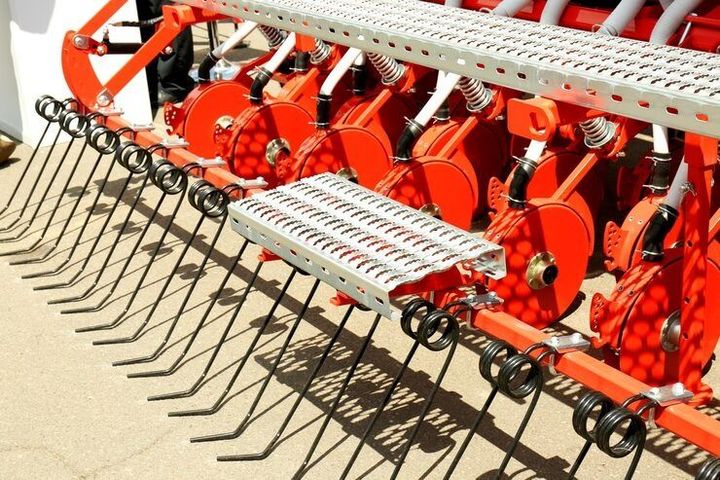
- Planting and seeding equipment
- Irrigation equipment
- Fertilizer application equipment
- Crop protection equipment
- Harvesting machinery
- Hay and forage equipment
- Material handling equipment
- Post-harvest processing equipment
The equipment used on a farm can vary significantly depending on the crops grown and the farming system.
How Agricultural Equipment Has Developed
The development of agricultural machinery has been closely connected with the need to perform repetitive field operations more efficiently. Early mechanical equipment reduced dependence on manual work, while later machines introduced hydraulic systems, electronic controls, sensors, and automated functions.
Today, agricultural machinery can combine mechanical components with digital technologies. Positioning systems, field sensors, electronic controllers, cameras, and data platforms can support more controlled agricultural operations.
Importance
Agricultural equipment plays an important role in modern farming because many agricultural activities involve repetitive operations across large areas. Machinery can assist with tasks that would otherwise require substantial amounts of manual effort and time.
Equipment also helps farmers perform operations within specific agricultural windows. Soil preparation, planting, irrigation, crop protection, and harvesting may need to occur under suitable field and weather conditions.
How Equipment Supports Farming
Different machines address different stages of agricultural production. A tractor can provide power for several implements, while specialized machinery can perform particular tasks such as planting rows or harvesting crops.
Agricultural equipment can support:
- Soil preparation and cultivation
- Seed placement and planting
- Water distribution
- Fertilizer application
- Crop monitoring and protection
- Harvesting and collection
- Transport and material handling
- Cleaning and post-harvest processing
Factors Affecting Equipment Use
The performance of agricultural equipment depends on the relationship between the machine and its operating environment. Soil type, field size, crop spacing, terrain, moisture conditions, and weather can all affect machine operation.
Machine capacity also needs to correspond with the scale and timing of the agricultural task. A machine that is suitable for one farm may not be appropriate for another because field conditions and operational requirements differ.
Recent Updates
From 2024 through 2026, agricultural equipment development has increasingly focused on automation, precision agriculture, connectivity, electrification, and data-based field management. These developments are part of a broader shift toward integrating machinery with digital agricultural systems.
Precision agriculture technologies can combine equipment with satellite positioning, field maps, sensors, cameras, and software. These systems can help identify differences within a field and support more controlled application of agricultural inputs.
Automation and Autonomous Equipment
Automation is becoming more visible in agricultural machinery. Automated steering systems can help equipment follow planned field paths, while machine-control systems can regulate certain operations according to programmed settings or sensor information.
Autonomous agricultural machines are also being developed for activities such as crop monitoring, weeding, transportation, and field operations. The level of autonomy varies between systems, and many technologies still involve human supervision.
Electrification
Electrification is another area of development, particularly for smaller agricultural machines and equipment used in controlled environments. Battery-powered systems can be used for some compact equipment, while larger agricultural machinery continues to use a range of power technologies.
The suitability of electric equipment depends on factors such as operating time, required power, battery capacity, charging infrastructure, field conditions, and machine size.
Connected Machinery
Connected agricultural equipment can transmit operational information through digital communication systems. Data may include machine location, operating hours, fuel or energy consumption, field activity, and equipment status.
These systems can help organize field records and monitor equipment use. However, their usefulness depends on network availability, data quality, system compatibility, and appropriate data management.
Laws or Policies
Agricultural equipment is influenced by different laws, standards, and government programs depending on the country and type of machinery. In India, agricultural mechanization is supported through government programs that provide frameworks for improving access to farm machinery and equipment.
The Ministry of Agriculture and Farmers Welfare operates the Sub-Mission on Agricultural Mechanization (SMAM), which focuses on increasing the reach of farm mechanization and improving access to agricultural machinery. Government information describes support for agricultural machinery through mechanisms such as financial assistance and custom hiring arrangements, subject to applicable rules and eligibility requirements.
The Indian Council of Agricultural Research and agricultural universities also provide technical information concerning farm machinery, crop production, mechanization, and equipment operation.
Machine safety is another important consideration. Equipment with rotating components, cutting mechanisms, moving parts, hydraulic systems, electrical systems, or high-powered engines can create physical hazards if operated incorrectly.
Applicable workplace and machinery requirements may involve equipment guarding, operator training, protective equipment, maintenance, electrical safety, and safe operating procedures. Specific requirements depend on the equipment and location.
Agricultural machinery may also be subject to standards administered by the Bureau of Indian Standards and testing requirements through recognized agricultural machinery testing institutions. Requirements can vary according to equipment category and applicable regulations.
Government schemes and technical requirements can change over time. Users should therefore check current official guidance before making decisions involving agricultural machinery programs or regulatory compliance.
Tools and Resources
Several resources can help readers understand agricultural equipment and plan machinery use.
Agricultural Machinery Specifications
Equipment manuals and technical specification sheets provide information about engine or motor power, operating width, capacity, dimensions, weight, attachment requirements, operating speed, and maintenance procedures.
These specifications can help compare equipment with the requirements of a particular agricultural operation.
Farm Machinery Calculators
Agricultural machinery calculators can be used to estimate theoretical field capacity, operating time, fuel or energy use, and related operating factors. Basic calculations may consider working width, travel speed, field efficiency, and total field area.
A simplified field-capacity calculation can be represented as:
Field capacity ≈ Working width × Operating speed × Field efficiency
Actual performance can differ because of turning, overlap, field shape, soil conditions, loading, unloading, and other interruptions.
Government Agricultural Resources
India's Ministry of Agriculture and Farmers Welfare provides information about agricultural schemes, mechanization programs, farming technologies, and related policies. State agriculture departments can also provide information about region-specific programs and requirements.
Agricultural universities, research institutions, and machinery testing centers can provide technical references concerning equipment performance, operation, and agricultural practices.
Equipment Planning Table
A basic planning table can help organize machinery requirements:
| Agricultural task | Common equipment | Important planning factor |
|---|---|---|
| Soil preparation | Plow, cultivator, harrow | Soil type and working depth |
| Planting | Seeder, planter | Crop spacing and seed rate |
| Irrigation | Pump, sprinkler, drip system | Water requirement and field layout |
| Crop protection | Sprayer, applicator | Crop type and application method |
| Harvesting | Combine, harvester | Crop maturity and field conditions |
| Material handling | Trailer, loader | Load type and transport distance |
| Post-harvest work | Cleaner, grader, dryer | Crop characteristics and throughput |
FAQs
What is agricultural equipment?
Agricultural equipment includes machines and tools used for farming activities such as soil preparation, planting, irrigation, crop maintenance, harvesting, transportation, and post-harvest processing.
What are the main types of agricultural equipment?
Major types include tractors, plows, cultivators, seeders, planters, irrigation equipment, sprayers, harvesters, balers, trailers, loaders, and post-harvest processing machines. Each type is designed for particular agricultural operations.
What are the main components of agricultural equipment?
Components vary by machine but may include an engine or electric motor, transmission, hydraulic system, frame, wheels or tracks, controls, working implements, electronic controllers, sensors, and safety guards.
How is agricultural equipment selected for farm planning?
Planning generally considers farm size, crop type, soil conditions, terrain, field layout, operating season, required capacity, available power sources, storage, maintenance requirements, and compatibility with existing equipment.
How is technology changing agricultural equipment?
Modern agricultural equipment increasingly incorporates positioning systems, sensors, cameras, automation, electronic controls, connectivity, and data-management systems. These technologies can support more precise operation and monitoring while reducing the need for some repetitive manual controls.
Conclusion
Agricultural equipment supports many stages of modern farming, from soil preparation and planting to harvesting and material handling. Equipment types, components, and features vary according to crop requirements, field conditions, machine capacity, and operating methods. Recent developments have increased the use of automation, precision agriculture, connectivity, and electrification. Effective agricultural equipment planning requires consideration of the farm environment, operational requirements, safety conditions, and applicable government or technical requirements.